Thursday, February 3, 2011

Cloudy, with a chance of snow....

I can’t think of a better winter season to undergo a massive restoration project – can you? What are the delays in work that massive amounts of snow, sleet, freezing rain and subzero temperatures cause compared to the satisfaction of conquering a challenge (or in the case of this past month, the multiple challenges) Mother Nature has thrown our way? Sure it’s cold at the house and we find ourselves making ridiculous excuses to sit in the bathroom (which just happens to be the warmest room in the house at this point – no kidding it’s sauna-like), but that doesn’t mean we aren’t enjoying ourselves.


But those delays are annoying. The meeting that was supposed to take place last Wednesday amongst the Director, Curator, Western Building Restoration, the architectural team, our Parks (New York State Office of Parks, Recreation and Historic Sites) contact and Shade Lady did not happen. Bad weather to the south forced the cancellation of the meeting and clearly there hasn’t been an opportunity to reschedule given the combined hysteria of local and national weather forecasters when there is any precipitation headed our way. So structural work is pretty much at a standstill.

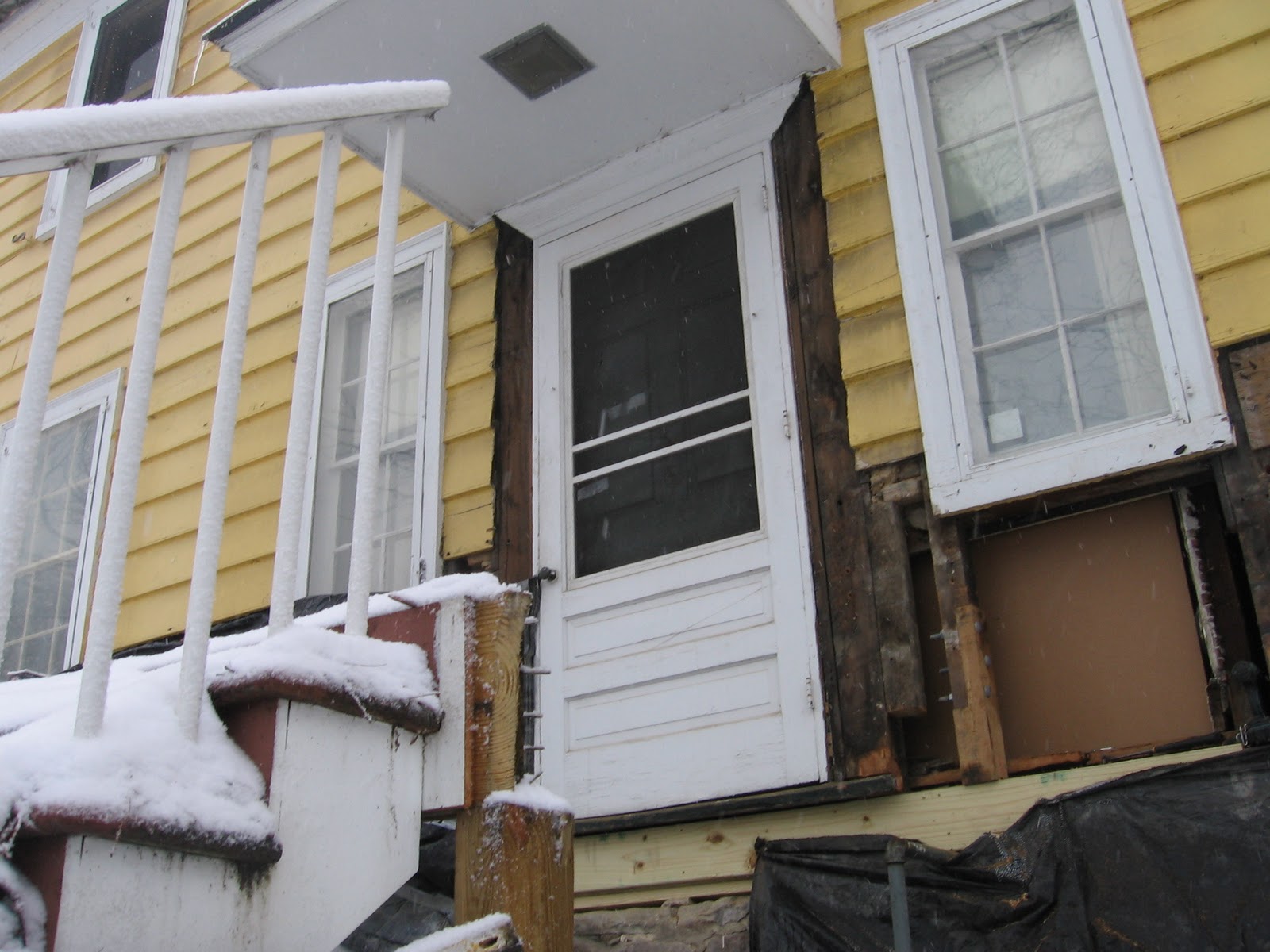
The last time I checked in with Joe the Hammer, about a week and a half ago, I was surprised to find out how busy he had been. For starters he had removed the front porch stairs from the house in order to access the sill located under the front door.

The Great Divide

A Close-up of the Great Divide
At some point in the museum’s past, sill repair had been made at this section (under the front door) but unfortunately those previous repairs were not well done. There was no overlap between the boards used for the previous sill (meaning that the sections of wood used for the sill had gaps in between), and none of the exterior posts were sitting on the sill, they were hanging in the air.

Warning - This is an photo of the old sill that has already been replaced on the northern side of the east facade.  I'm using it to illustrate what a sill with some overlap looks like - as you can see there are gaps in between the pieces of timber where there is no overlap.  Now imagine an old sill with no overlap at all and that is apparently what the sill looked like under the front door before The Hammer replaced it.
The Hammer replaced the old sill with 3ft and 4ft sections of wood to create the new sill.

Partial view of the new wood used to replace the old sill under the front door.
He also had been busy constructing scaffolding at the southern end of the front of the house, including inserting the needle beams into the house (anchored to lally columns on the ground), all in preparation for sill work on the southern end. The meeting that never happened, once it does happen, will be critical to determining how to move forward with sill work on the south end. The sill looks bad to me, like it would take buckets of epoxy to make it structurally sound again – but then again, mine is the untrained eye. I think a crack in the plaster wall in my bedroom portends a disaster of epic proportions in the making, but my husband tells me to stop wearing his hockey helmet to bed and accept that it is just a side effect of the settling of the house. Clearly I’m not the right person to decide what looks bad or not.

Although no work can go forward on the sill, The Hammer made Dutchman repairs to the exterior posts with an eye towards the impending sill work to come, meaning that although the sill may have to be replaced, his repairs are removable in order to accommodate the future sill work. The Dutchman repairs can be unbolted and removed if necessary. The Dutchman repair has a tenon, or projection at the end of the wood post, for insertion into a mortise joint. A mortise is a cavity cut into wood to receive a tenon. If the sill needs to be replaced, a mortise joint will be cut into the new sill timber for each tenon on the repaired posts to sit in.

Picture shows some of the exterior post repairs that Joe the Hammer has completed.

Joe the Hammer is holding wood pieces that will be used in the Dutchman repair of one of the original posts.  The tenon is the piece that extends at the bottom. 
In addition to the work Joe the Hammer has done on the exterior of the house, he also was able to put the lath back up on the wall in the north parlor. All that remains is for the walls to be plastered and then the interior work in the north parlor will be done. Since he has done all of the sill work that can be done at the present, The Hammer has turned his sights to removing more windows from the house to take to Western’s workshop for restoration work.

The lath is back!!

Beyond that – the restoration work awaits a lull in the storm systems to hold that much anticipated meeting which will decide the fate of the sill on the southern side of the east façade. Until then, the staff plans to stock up on carbs to outlast the bitter cold. Luckily we have a ready supply of carbs at Uncle Dan’s Diner located down the block from the museum. It’s not an easy job, shoveling food into our mouths as if we’re preparing for hibernation, but it is necessary if we want to make it through the cold weather to the spring. Of course, with the types of carbs we’re ingesting, we don’t have any idea what we’re going to look like when springtime rolls around (mmm, rolls…) - but as my favorite hoop-skirted southern belle Scarlett O’Hara said, “I can’t think about this now. I’ll go crazy if I do. I’ll think about it tomorrow.”

As God is my witness, I'll never be hungry again!  Especially if my carbs are smothered in cheese.

Tuesday, January 25, 2011

We laughed, we cried, we allegedly committed murder....

I had no idea when I agreed to go on a road trip with the Director and the Curator two weeks ago, that the trip would begin at the Police Station, continue with a hit and run, and end in Mexico.

Thursday morning, January 13th, started out pleasantly enough – I was super excited about the prospect of a peppermint hot chocolate from Starbucks (with whipped cream thank you very much sir, do you really need to ask?). In comparison, I may have been slightly less excited about the window sight-seeing tour we were about to embark on but then again I have never made secret my delight in all things edible and unhealthy. As our departure time was a bit fluid, and as the Director hadn’t arrived yet, I sat down at my desk to get in a little bit of work before we left. Reflecting smugly on my productivity and work ethic, I answered the ringing phone in my most friendly and engaging voice, albeit in a voice register somewhere between that of a pre-adolescent choir boy and Minnie Mouse.

Me: “Good Morning, Historic Cherry Hill. How may I help you?”

Caller: “You’re not going to believe this.”

Me: “Director?”

The Director formerly known as Caller: “My car has been towed. There was snow emergency parking last night and when I came out this morning my car was gone!”

Me: [Silence while an internal battle raged to suppress any unsympathetic sniggers or giggles]

The Director: [Panicked breathing]

Me: “Do you know where your car is?”

The Director: “No! I have to call the city…maybe we could rent a car for the drive.”

Me [slightly offended that the Director would rather rent a car and drive then let me drive us all in my minivan]: “We can take my car.”

The Director: [Long Pause] “I’ll call the city. Can you guys come and pick me up at my place.”

Me: “Okay.”

About twenty minutes later the Curator and I pulled up to the side of the road to pick up a very annoyed Director. The Director climbed into the van (whose “high-tech” handle proved too difficult for her to master on her first try) and directed me to our next destination. THE POLICE STATION!

As I parked the car in THE POLICE STATION! parking lot, the Curator and I eagerly exited the car and practically skipped to accompany our fearless leader inside the citadel of justice. The Director didn’t seem to appreciate our show of support, particularly because the support was offered with barely suppressed glee. We walked into THE POLICE STATION! with our Director leading the way like we were a couple of overexcited puppies she was trying to control. While she attempted to communicate (communicate = shout back and forth) through a tiny hole in a glass window with an officer in blue on the other side, the Curator and I sized up the space, eagerly watching as more miserable Albanians shuffled in, a rag tag group of snow emergency parking victims and…others. Unfortunately we were only there for a very short time, but it was long enough for The Director to sign some paperwork, obtain the location of the tow-company that took her beloved car, and weasel her way out of some overdue parking tickets Officer O’Malley discovered she owed during the whole process. I don’t think she was enjoying the experience as much as we were. I high-fived a man resembling Grizzly Adams on the way out the door, and shouted "Power to the People!" before we emerged into the sunlight to sniff the sweet smell of freedom, a heady mix of car exhaust and stale urine.

We hopped back into the van and made our way to free the Director’s car. We had to go inside the tow-company’s office where the Director once again “communicated” with someone through a tiny hole in a glass window and then paid the cost of the tow before being gifted with the location of her car - something along the lines of “It’s in the lot at the back of the building.” Into the car we piled again and I drove the director to the lot at the back of the building which we found to be filled with cars in varying degrees of burial under the snow. For a moment it looked like the Director’s bad luck was going to hold and we would have to play a game of Marco Polo with her car using the panic button on her keychain, but much to the disappointment of both the Curator and I, the Director located her car quickly.

So the road trip was on – but first we had to go back to the museum to drop off my car and climb into the newly recovered car of the Director. But once we climbed in – the road trip was on! To the first rest stop on the Thruway heading south where coffee and hot chocolate was purchased. But after that – the road trip was on!

We traveled to Katonah, NY to visit Stepping Stones, a historic house museum. The house was the home of Bill Wilson, co-founder of Alcoholics Anonymous, and his wife Lois, co-founder of Al-Anon Family Groups. The Executive Director of Stepping Stones greeted us, winter hat on head and guided us along a snow covered path, approximately the width of a single human foot, from the office building to the historic house. As I attempted to place one foot in front of the other on the path across what in my mind seemed more akin to a frozen tundra in northern Russia than a yard in Westchester County, I reflected for the 17th time in my life that my sense of balance was more suited to a one-legged clown than a two-legged Communications Coordinator.

Stepping Stones has recently installed exterior storm windows similar to the ones we are planning to install at Historic Cherry Hill. Our trek through the snow afforded us a lovely view of the house and its exterior windows. I dutifully snapped pictures while the museum professionals talked about UV filtration, window installation and things of that nature.

The exterior storm windows seen here at Stepping Stones are similar to what Historic Cherry Hill will install.
Close up of an exterior storm window at Stepping Stones

What did grab my attention after looking around the first floor of the house, (once again while the real professionals conversed), were the measurement instruments the Executive Director of Stepping Stones brought along to take some measurements with. She had both a visible light measure and a UV light measure. The Curator was instantly drawn to the measurement devices like a Communications Coordinator is drawn to cheese fries – picking up the visible light meter, she began figuring out how the device worked. It took some time to understand what the readings meant in terms of measurement of light (lux) but eventually she clued us in on the following:

Level A: 0-1999

x1 lux

Level B: 2000-19999

x10 lux

Level C: 20,000-50,000

x100 lux
The visible light meter - I will confess I was a little disappointed to find that the light meter was not similar in any way, shape or form to the lightsabers from the Star Wars movies.

These readings may not mean anything at all to anyone who isn’t holding the instruction booklet to the light meter in their hands, and even then, if you’re like me, it still won’t mean anything to you. However I was lucky enough to have the Curator with me and she being, (I think), a direct descendant of Mr. Wizard, was able to talk me through the process. We took visible light measurements in one particularly sunny room and were amazed at the difference in light measurement when a window was covered with sheer curtains versus when a window was devoid of  window treatments.  The amount of visible light that traveled through a bare window was reduced by almost 57% with just the addition of the sheer vurtains. 

Because visible light poses such a danger to collections, museums in general strive to keep lux levels low but in such a way that a visitor can still enjoy the full color of the objects they are looking at.  In the best circumstances, a person needs a minimum of 50 lux to still be able to see - it is a level that museums aim for.  Now, the lux requirement will go up depending on the conditions of the room and the needs of people viewing the room. For example, one would multiply 50 lux by 3 to accommodate the vision of an elderly person; one would multiply 50 lux by 3 if looking at a low contrast object in the room; one would multiply by 3 if there are dark paintings on view; one would multiply by 3 if there was fine detail on an object on view. So if an older person came into a room to look at a dark painting and also examine the fine detail of the painting’s picture frame – you would multiply 50 lux by 3, by 3, by 3 to get a necessary lux measurement of 1350 lux which a musuem would need for that older visitor to comfortably view the painting and all its detail.

Moving on to the next gadget: the UV light meter. The Curator took some measurements which I dutifully recorded. We took the UV light measurements in several different spots in the house. Since we weren’t as confident in our understanding of what the UV light measurements meant, i.e. what UV range was acceptable in a museum environment, we took the measurements home to analyze another day. We want to understand how effective the UV filter in the exterior storms is as we are relying on that to filter out UV light in our museum.

This picture of the Curator holding the UV light meter is going in her hand-modeling portfolio - we're hoping it will be her lucky break.
This is an example of an ancient Greek scroll...wait a minute, no...my mistake, that's got something to do with the UV light sensor.

We left Stepping Stones to head to our next destination, Olana State Historic Site, in Hudson, NY. Our plan was to check out the “screeney blinds” Olana used on their windows, to see what our opinion was of them. Instead of taking the Thruway north we made our way to the Taconic State Parkway, deeming that the faster route. Little did we know what horror awaited us halfway to our destination. Driving along, the Director and the Curator in the front seat, myself in the back, things seemed to be going well. We were a little bit ahead of schedule and congratulating ourselves on that feat. Only another hour or so and we would be to Olana. Then the unthinkable happened. A blur in the sky, a thump on the front bumper of the car. The Director kept driving while I sat in the back seat, gasping in horror, my eyes wide with the realization that I had just witnessed a hit and run. Leaning forward, trembling hands clasped as if in supplication to the almighty Director to “say it ain’t so”, I stammered out the question – “Did you just hit a bird?” to which the Director replied, “Yeah….I did.” And there the three of us sat, all guilty of taking the life of a harmless little bird. The weight of our guilt weighed heavily on us for a couple of seconds, but then the Director said, “I think I just stunned it.” And, call me crazy, but I believed her – sure we were going over 60 mph and the thing took a kamikaze dive into the hood of the Director’s car but gosh darn it, yes, I agree, the Director probably just stunned it.

R.I.P.
2010-2011

Arriving at Olana, after taking a solemn blood oath to never breathe a word of our heinous deed to anyone on pain of immediate termination of employment (the Director’s idea), we were greeted by Olana’s curator who brought us into the house to view the “screeney blinds,” although she just called them solar shades. The thing about Olana, in case you aren’t aware, is that this house was built for the views out its windows, and those views are stunning. I was skeptical, thinking that the “screeney blinds” would intrude too much into my personal enjoyment of those views. I was pleasantly surprised to realize that it wasn’t as bad as I imagined. Of course nothing can compare to an unimpeded view of the Hudson River from Olana’s hilltop perch but the view through the “screeney blinds” was acceptable. We left Olana rethinking our previous stance on the “screeney blinds” question and took a quick drive across the Rip Van Winkle bridge to take a look at Thomas Cole House which had the same “screeney blinds” but in white to see the different options available to us.

Olana State Historic Site - it sits on a magical hill that has flowers and blue skies even in the middle of January (at least that's what I am pretending, having lifted this picture off its website)

After all of the “site”-seeing ( a little historic house humor for you) we were ravenous as we hadn’t stopped for lunch and it was about 5pm, so we crossed the Rip Van Winkle bridge one more time and took the road to Mexico. To be a little more precise – to Mexican Radio a great Mexican restaurant in Hudson, NY which incidentally serves phenomenal pitchers of raspberry/blackberry margaritas – not that I know that from first hand experience – a little birdie (recovering from severe head trauma as the result of a car accident) told me.

People whose conscience weighs heavily on them for some crime they have committed will often turn to drink.  I know when an evil deed has stained my soul I prefer to drink something fruity and colorful.


Thus ended our road trip, although the Director and the Curator went on another trip the next day to The Hyde Collection in Glens Falls, NY to take a look at what that site did with their window restoration. They used tinted Plexiglas on the interior which they covered with sheer curtains that made the tint practically invisible. The Light Guru created a complicated and extensive artificial lighting system in their rooms that was so genius it is difficult for a visitor to tell where the light in the room comes from.

As of now, taking in all of the observations made on the trips to different sites as well as the opinions of different experts in the field, the Curator is leaning heavily toward blocking the visible light in our museum with shades. There is a meeting scheduled for this Wednesday with our architectural team and a “Shade Lady” after which a final decision will be made as to how we want to tackle the issue of visible light.

Friday, January 14, 2011

The visible light is so bright....I gotta wear shades (or tinted Plexiglas or fiber mesh screens, or...)

And here I thought tinting glass was just for the cars of male teenagers and diplomatic envoys - turns out I was mistaken. Apparently tinted windows are all the rage in the museum world. I found out more than I ever wanted to know about light filtration options for windows this past week.


But I’m confusing you – let me start from the beginning. I talked with the Hammer last week for updates on the progress of the restoration work. He has been working on shoring up the south side of the house – C channels, needle beams are in, most of nogging is out. Hey (Jude) was expected on site to take pictures of the exposed sill to share them with the architectural team so that they can make a determination about what type of sill and post repair is most appropriate. Until the architectural team makes that determination, no sill or post work can be done. Hey (Jude) was also supposed to bring a storm window mock-up for the architects’ approval as well.

View of the South Parlor - site of the next phase of structural work.


Scaffolding in place, check!

C-beams and needle beams in place, check!


Exposed sill in need of some type of repair or replacement the extent of which is not known at this point, check!
 I figured – ‘Whew! This is going to be a short and sweet blog this week!’ Had I talked with The Hammer alone it would have been, and I would have remained blissfully ignorant of The Great Glass Dilemma of ’11. However the Curator accompanied me on my fact-finding mission and when The Hammer mentioned storm windows, she began to ask questions. The questions revolved around the advisability of tinting windows. But the bigger story is UV A, UV B and visible light. I’m well aware of UVA and UVB – they are the reasons that when at the beach I slather on the SPF 107 sunscreen, wear a sweat suit under my bathing suit, and make my children walk around in their snowsuits while they build castles in the sand. Visible light – not as afraid of, mostly because it allows me to see. But visible light is not the innocent little range of electromagnetic radiation that can be detected by the human eye it tries to make itself out to be. While it is true UV A and UV B light causes degradation of material, visible light does its fair share of damage – it fades things.

According to the Curator because we do not need UVA or UVB light to see it can be eliminated almost entirely (hence the SPF 107 and the sweat suit under my bathing suit – my family thinks it’s overkill, I think it is a safe way to enjoy the sun). However we need visible light because without it we can’t see. The museum’s goal then is to reduce the amount of visible light that enters through the windows into the house to the minimum levels necessary to see. The good news is that it seems like any glass will block UV B radiation while applied filters will block UV A. But what to do about that pesky visible light?

Well, what are the options? Aaaah…ha ha – if only that were an easy question to answer. One option is to apply a tint to the exterior glazing of the window to filter out visible light. The percentage of visible light filtration you want dictates the amount of tinting necessary. And don’t think there is only one tinting option out there for glass – there are more, for example, bronze tinting or gray tinting – and I have no idea what either of those two things would look like. Tinted glazing for controlling visible light is usually done in the museum world on interior storms made out of Plexiglas. But the museum is not mounting interior storms, it is mounting exterior storms. And regular glass will not be used in the exterior storm windows – instead the exterior storms will be made with safety glass. The reasoning behind this is simple – we want to protect the historic fabric of the house that we are currently spending mucho dinero to restore. In other words we don’t want a thousand black birds to fall from the sky dead and have a portion of those dead black birds crash through our windows damaging any of the historic material of the house. (Actually we don’t want a thousand black birds falling dead from the sky period – that’s a little too end-of-times for me) Safety glass will break but it won’t shatter all over the place. Besides, the Plexiglas is easily scratched – that’s okay when it’s on the inside, but it would start to look pretty bad on the outside what with its exposure to dead birds falling from the sky, etc.

Darn those Mayans and their calendar!

One of our concerns with tinted exterior storms is the way the house will look with all of that visible light reflecting back off. Sunglasses can make movie stars look cool, or State Troopers look intimidating, but in the case of Cherry Hill it will only succeed in blinding anybody who looks at the house on a bright, sunny day. Rule number one in the Dummies Guide to Historic House Museum Interactions with the Public – do not blind the public. The Curator did wonder if there was an option of applying an anti-reflective coating to exterior tinted storm windows that would reduce the amount of reflection/potential blinding of passerby.

Long after the interrogation of Joe the Hammer had ended, the glass discussion carried on (and on…and on, I’m not kidding – like for the rest of the week). The Director and the Curator mentioned that there are fiber mesh shades that can be mounted on the interior of the window to reduce visible light. Actually, in the interest of full disclosure and since this is supposed to be a helpful and informative blog, the Curator and the Director used their “official” name for these shades: “screeney blinds.” The plus of the “screeney blinds” is that they will block visible light in a non-permanent way; the negative is that they provide a less clear view out of the window they are mounted on. Some staff members (the Curator) were open to the idea of exploring the option, other staff members (the Director) were vehemently opposed and then there were the staff members (the Communications Coordinator) who were stumped over how to spell “screeney” - (“Do I put the third ‘e’ in or do I leave it out?”).
The other option is to continue the method currently in use at the house - blackout shades and UV shades that staff members have to remember to raise for a tour and then lower after tours are over. A little more manual effort certainly but it does the job, once again in a non-permanent way.

Just when we thought we would continue to wander in a forest of UV and visible light uncertainty we found enlightenment. The Curator contacted The Light Guru. The Light Guru answered her questions and gave her a sense of calm where before there had been only a tinting tizzy. The Light Guru is a private conservator who happened to design the HVAC system for the museum’s collections center. The Light Guru explained that the tinting levels we would need might not be available in laminated glass. He explained that if we wanted to go the tinted route that we should get Plexiglas tinted to whatever percentage of filtration we wanted and install that between the historic glass and the exterior storm – the thought being that the exterior windows might look better this way. He suggested that the museum measure the light levels of the windows using a footcandle sensor device or a light meter. (Light is measured in footcandles or lux.) Once we know what amounts of visible light we are dealing with, we will be able to make a better informed decision.

But not to be outdone by the Curator’s window nirvana, the Director pulled a card from up her sleeve and contacted another conservator who has worked with the museum before, via a mini-teleconference (in the interest of protecting her privacy we will refer to her as the Conservator Extraordinaire). The Conservator Extraordinaire actually suggested we contact The Light Guru in the first place and when we talked with her after The Light Guru’s enlightenment, she gave us some food for thought – she suggested the use of tinted Plexiglas on the interior which would lower the amount of light coming in the window, make window treatments last a lot longer and prevent an Apocalypse Now (unless you are a black bird in Arkansas) if a staff member happens to forget to shut any of the blinds or shutters. It is an option of continuous protection that takes the manual labor associated with the UV and blackout shades option out of the equation, and lowers the baseline of visible light that enters a given window.

The Curator, whiz kid that she is, is currently thinking about a different approach to visible light management. The museum could use pull-down blackout shades when it is not open, and when it is open to tours (an optimal time to let visitors have some visible light so they can appreciate their surroundings) the blackout shade would be fully raised. But what about the visible light and the UV A light?!?! Never fear – in addition to the blackout shade would be a fully closed semi-translucent shade which would allow light to enter the room more evenly but in a reduced amount. The museum would use reproduced historic window treatments or adaptations of them for further reduction of light. But just to complicate what seems like a simple straight forward method to deal with visible light, the Curator will explore different options in different rooms of the house. Perhaps in one room, like our Guest Bedroom where the view out the window is part of the tour – maybe tinted Plexiglas would be installed there. All those light measurements The Light Guru suggested will come in handy making these decisions.

After all of the talking and after the advice of the conservators, it became painfully clear to the Director and the Curator what needed to be done……..Road Trip!!! Obviously in order to make the most informed decision possible, in addition to light measurements and advice from the experts, we need to see how these different options look in the real world, or at least the real world of historic house museums. And we also need to buy some snacks for the road. I’m thinking Slim Jims and Cheetos. But no coffee – can you imagine how many bathroom breaks the Director and Curator would have to take on a road trip where they were given coffee in the car? To this end the Director and the Curator have set up some visits to sites this week to help with their research. I have been invited on the trip, and if weather and childcare conditions allow, I will go along for the ride. The only thing I have left to say is “SHOTGUN!” (Sorry Curator but it’s an unspoken rule of the road – whoever shouts SHOTGUN first gets the front passenger seat.)


***Updated Information – We have since found out that it is possible to get laminated glass that is tinted dark enough. The catch is that the extra layer of tinting to the laminated glass “sandwich” may not look well and it may end up being too thick to be physically feasible for the museum’s particular windows.***

Thursday, December 30, 2010

When it snows, ain't it thrillin'...

Unless that snow is accompanied by blowing winds and sub-zero temperatures, and a death-defying (at least in my mind) ride down I-90 and 787 on highway roads that were of the “Make-Your-Own-Car-Lane” variety.


Monday, December 27th – a day that will live on in infamy, (once again, at least in my mind). It began at 6am when my husband roused me gently from sleep (with a shove to the side and a growled “Get up! The alarm went off!”). It took me a few moments to open my eyes and remember where I was. But once I did I bounced out of bed, fingers and toes crossed in the hopes that either the snow was sooooo bad that nobody would ever venture out in it or that the weather forecasters had once again made a mountain out of a couple inches of snow. Neither hope won out. The snow was not so bad that nobody would ever venture out in it and the forecasters had been pretty accurate in their predictions. My husband obligingly got out of bed and dressed, as did I, in preparation for snow shoveling. Never fear concerned readers, my mother-in-law, moved to action by my pathetic admission of bootlessness in my last post, gifted me with a pair of bona fide boots for Christmas. That was the one highlight of my morning – slipping my feet in to nice warm boots and having said footsies stay dry while I got a cardio workout shoveling snow. The snow wasn’t too heavy but there was a lot of it. A lot of it. I paused for a moment in wonder as a backhoe made a third trip around my street to clear it of snow. A backhoe? Things must be bad out there.

By 7am the driveway had been shoveled and the cars cleared of snow. Mother Nature had thoughtfully deposited another ½ inch of snow on the space already cleared. I walked back inside, checked weather reports one more time, praying for some statement prepared by the Government of New York State advising New Yorkers in general, but Historic Cherry Hill’s Communications Coordinator in particular, to stay off the roads. A call from the Director came and like a child waiting breathlessly for news that school was cancelled, I leaped at the sound and answered. No such luck. Apparently in the real world, people with jobs are expected to go to work. Crazy, crazy notion. The word from the Boss was that Joe the Hammer was coming in to work. Since I had foolishly volunteered to take the early shift for once (of course on the first major snowfall of the year) it looked like the restoration project, like the postal service, would be stopped by nothing - I was heading for work. My husband, stood with concern, watching my departure. Or at least I thought it was concern until I realized he was putting together the new snow rake he had just got and that his back was actually to me.

The roads were delightful, and I maintained a bare-knuckled grip on the steering wheel all the way to work. Once I arrived, after driving at a breakneck 30 mph on the highway I found that although the driveway had been plowed at some point, it was buried once again and that the city’s plows had blocked up both entrances. Luckily I had the foresight to carry a shovel with me, more because I thought for sure I would need it to dig myself out of a ditch, but happy to use it in a less dire situation. As I stood at the base of the driveway, shoveling out a big enough space to pull my car off of South Pearl Street, Joe the Hammer came driving up. With his window down he shouted across the road to me “We only got 1 ½ inches of snow where I live.” Which apparently is on the equator. With The Hammer’s arrival as my relief pitcher, so to speak, he took over the shoveling for me while I waded up the driveway and dug out the door to the museum to get inside and find another snow shovel. By the time I had located one in the outside ladder room, The Hammer had finished shoveling and he moved my car into the parking lot.

The Hammer’s inspection of the windows found that snow blew in around one of the temporary windows located at the back of the house. He cleaned up the mess and packed that window as well as other temporary windows with foam, (sealed with tape in some cases), to prevent a repeat occurrence in another room of the house. His plan for the day had been to work outside setting up the scaffolding on the south side of the east façade, in preparation for sill work! Joyous news. But for now, because of the wind and super cold temperatures outside, that work will be put off until weather conditions improve.

If you look closely, you can see some of the foam Joe the Hammer used to fill in space on either side of the window.
A close-up of the foam

Tape used to cover a gap.
The only temporary window which the snow was able to breach.
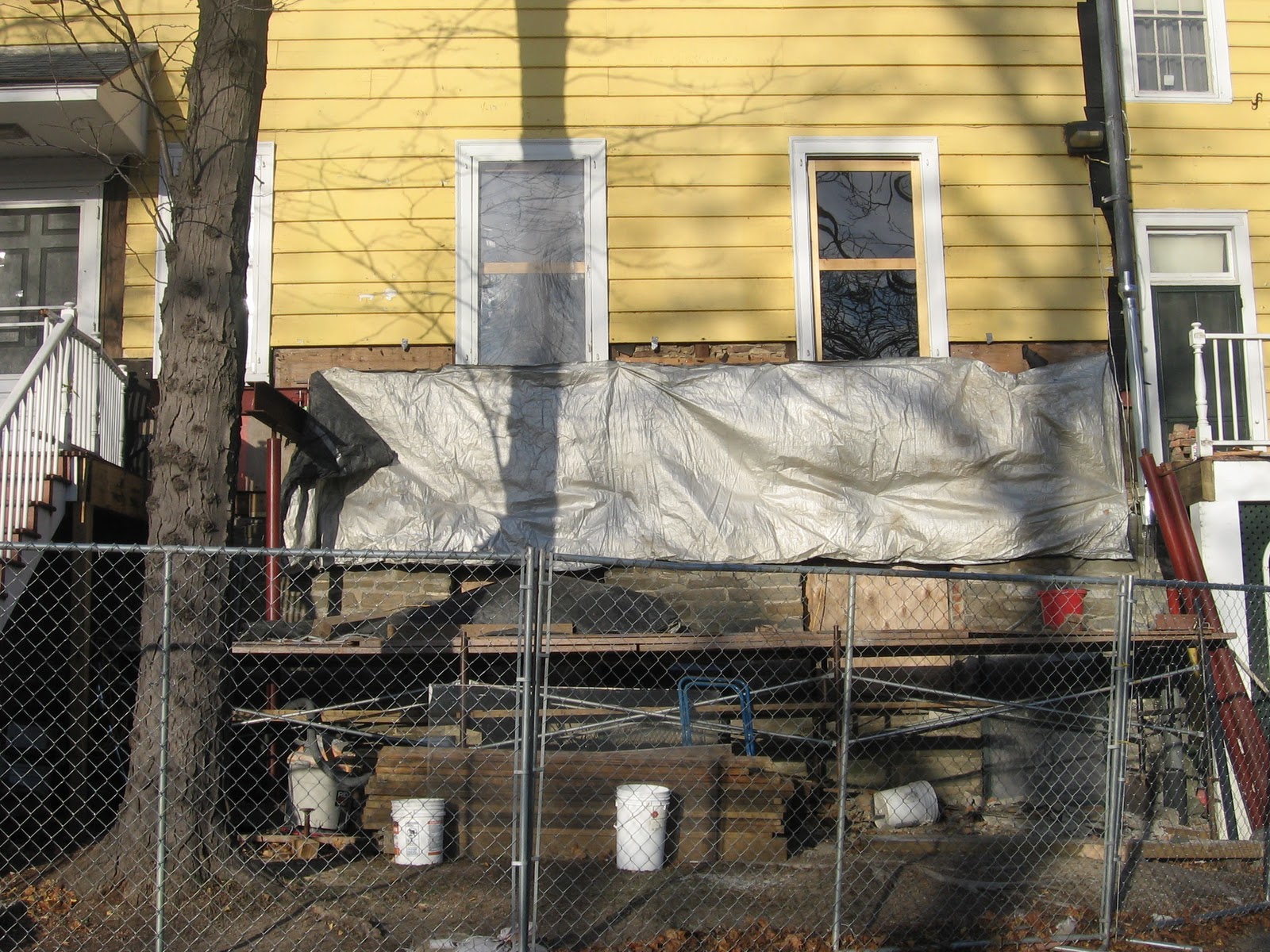
The south side of the east facade and the future site of scaffolding.
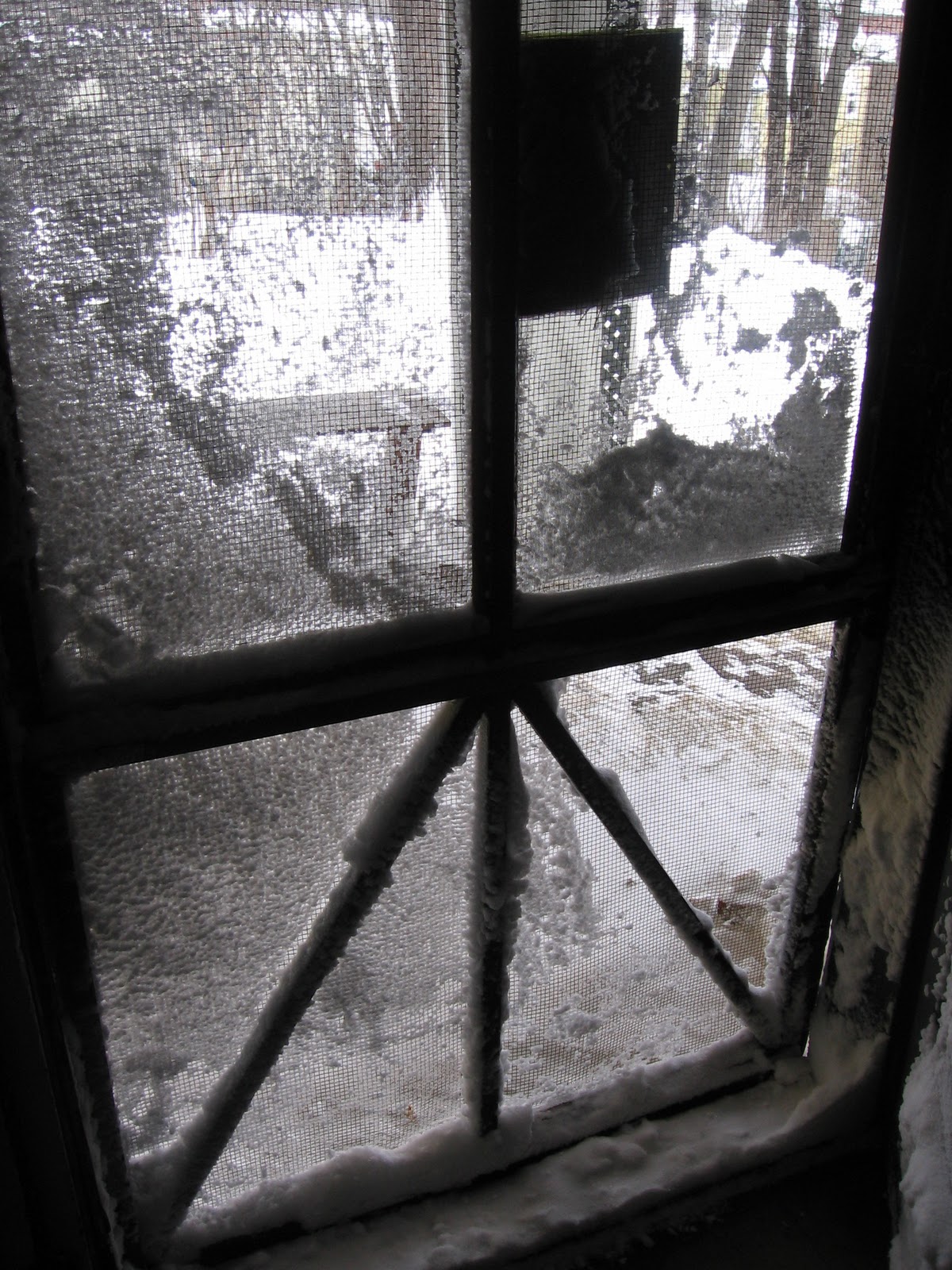
An example of how the blowing snow covered everything!  This is the screen door of the entrance into the museum.
The Hammer's car made it up the Hill but my poor little minivan didn't stand a chance.

Monday, December 20, 2010

Working in a winter wonderland...

It’s cold outside. It’s really cold inside. As I type, I am sitting huddled in my chair at the computer with my electric heater blasting and my sneakers sitting on top of it drying out. I don’t know if this is a fire hazard and quite frankly, I would welcome some flames just to thaw out the top portion of each of my toes. I know what you’re thinking – it’s winter, there’s snow on the ground, why are you wearing sneakers? If you must know I have no boots. There I said it. My name is Mary, I live in upstate New York, it is winter time, and I don’t own a pair of boots (not unless you count my bright yellow and blue rain boots which I do not because they offer no traction in the snow). Maybe some of you haven’t seen the video I made recently for Historic Cherry Hill’s End-of-Times, wait that was a typo, End-Of-Year Appeal on facebook. If you haven’t, let me just say my lack of winter boots is the least of my family’s worries.


If you watched the video, then you may be feeling sufficiently sympathetic towards me to not hold the “no snow boots” thing against me. By this time you must be able to tell that I’m not the brightest light bulb on the Christmas tree (I’m more along the lines of the one that blinks on and off randomly, you know, the one that you tighten, and it seems to light up nicely, but the next time you come into the room it’s off again), and maybe you’ll forgive me for lacking wintertime essentials. Any who – I was taking a long time to explain that it is cold. Period. Whether you are outside or inside the museum.

And because it is cold, I may have taken a perverse delight in the meeting that was held here at the museum last Wednesday. It was a meeting attended by the architectural team, Western Building, and Cherry Hill. Here’s where the perverse delight comes in – it was very cold that day, and all of the foreign dignitaries at the site had to suffer in the cold while they inspected the work. I acknowledge that at the end of the day they got to go back to their heated offices and wait for the feeling to return to their fingers, so it was really only a temporary discomfort to them, but still - they suffered. If I wanted to be fair I should say that the only heated place The Hammer gets to go on his workday is his car and that he is the only one who actually has to work outdoors and in the unheated section of the house, but I don’t feel like being fair. I bet his car is a lot warmer than my cave with its electric heater that even a caveman would turn his nose up at.

But where was I? I’m sorry, I’ve noticed that my memory is not what it used to be since the sensory receptors in my brain have frozen solid. Ah yes, the meeting at the Arctic Circle. I was not present for it (much to the relief of all involved as they knew: a) they wouldn’t have to repeat things in a slow and distinct voice; and b) they wouldn’t fear that any of their comments would appear in the blog) - I relied instead on the stellar recall of the Director and the Curator. Let’s just say that the basement windows aren’t the only thing affected by dry rot. (That’s just a little restoration humor – I know the architectural team and Joe the Hammer totally got that joke!) For all of you lay people, I was making a humorous comparison, implying that the recall ability of the Director and the Curator has been affected by dry rot as have the museum’s basement windows…but I kid. They were able to recall in stunning detail how cold it was outside.

A meeting of the Polar Bear Club...just without the water

And some other things.

First things first – the architectural team approved all of the work that had been done thus far. Joe the Hammer received praise for the quality of his workmanship.  (If only poor Joe could have heard their compliments but alas, the exposure to the elements had frozen his ear drums rendering him deaf.) The options for heating the inside of the house for work purposes was brought up. I may not have mentioned this but it’s cold in the house and cold outside. For the mason to put the nogging back in place requires mortar, which requires above-freezing temperatures to spread properly. Western will be using a 110-amp electric heater inside the house to provide heat in the North Parlor while work is done on the nogging and also for the window painting that needs to take place inside the house. There is still some talk about needing higher heat temps on the outside of the house to continue restoration work. The idea of a tent and a blower using 220 amps for heat was tossed around making the Director a little nervous as she considered that just running the vacuum cleaner inside the house tends to trip the breakers. Western will be bringing an electrician by to evaluate the museum’s electrical capacity before using the blower.

110-amp heater in the north parlor whose sole purpose is to keep the room warm enough for mortar work to be done.
Mortar work done in the north parlor, courtesy of the heating power of the 110-amp heater.
Mortar work waiting to be done.  You can see the original nogging in this picture, waiting patiently for its turn.

Both the architectural team and the restoration workers were in agreement that exterior painting would have to be postponed until the spring. We will now have to approach the New York State Office of Parks, Recreation and Historic Preservation (Parks) with the plea to allow us to run two EPF grants at the same time because if we push back the painting to spring, and if Parks does not allow us to use two grants simultaneously, then we’re going to be sitting back looking pretty and incidentally looking at a nice long delay in the restoration project as we wait for the spring thaw.

But put a check mark in the good news column because it sounds like (try and follow this) the south post in the north parlor located to the right of the front door (if you're facing the house), may not be in the terrible condition it was previously believed to be in. Yes it is floating in air - definitely not good, but the architectural team was pleasantly surprised to learn that the damage didn’t extend too far upwards in the post. Because of this the post may not need a dutchman repair with the white oak. It may be able to scrape by with an epoxy repair, specifically a structural epoxy, which when dry will be as strong as the beam of wood. The bonus with the epoxy repair would be less of a loss (say that five times fast) of the original wood. The group looked at the southwest corner post of the house. Once again there was hope that that post is not in as bad shape as was previously thought. Western and the architectural team will be looking at the report from the bore testing that was done previous to the start of the restoration project to reevaluate that particular post.

The Director is hoping that by having been a good girl all year, Santa might give her a southwest post in better shape than previousy thought.

Taking a break from the bitter cold outside, the group sought refuge in the bitter cold inside and inspected interior work. On their journey through the house they stopped to discuss a couple of windows that showed a serious degree of wood rot caused by water entry. As professionals are wont to do, they stood and discussed the various causes for the wood rot including the possibility that wind-driven rain may be responsible or that the way the window sill was constructed may be to blame ultimately concluding that they didn’t know the answer. After that illuminating conversation, the architectural team and Western teased the hopeful heart of the Director by mentioning once again that the south side of the east sill may be in better shape than previously expected.  (Wow, that feels like déjà vu – I have the feeling that I have written a sentence like that before - about structural elements being in better shape than previously thought.) Work in the north parlor is still continuing. The mason has mortared some of the nogging back in place. Once the nogging work is finished, and The Hammer gets some lath nails he is waiting on, he will be able to finish the work on the interior wall in the north parlor.

As exciting as inspecting work in the bitter cold can be, the group then got in their warm vehicles and took a trip to Western’s workshop where the window restoration work is being done. The Director and the Curator met the Window Fellows who are carrying out the restoration work on our windows. We know that the basement windows of the house are in pretty terrible shape due to dry rot, and it is questionable as to whether or not it is advisable to try and restore them. A decision must be made whether to restore them or not. If the decision is to not restore but build new ones it might seem obvious that we would restore them to be as authentic as possible – basically new exact copies of the original. While that is the obvious option there is still another option which we have to take into account when making this decision. The option behind door number 2 is to document and retain the existing window and construct a window that is authentic in the elements that will actually be exposed – but is not operable and thus has no pockets (which would not be visible once the window was installed).

It wasn’t all blissful heat and thawing out of the extremities for The Director and the Curator. They were faced with some tough questions concerning the exterior window hardware. You tell me if you could answer, on the spot, what color to make the hinge attached to the shutter, the hinge attached to the window frame and the shutter dogs. Not so easy is it? But like true Jeopardy champions, the Director and the Curator were able to pull it off under pressure and answer in the form of a question - What are three examples of the type of detail one must consider during a window restoration project? This is not an easy question to answer. First of all, the Director and the Curator were actually aware of this question as it was emailed to them a couple of weeks ago and they had been discussing it for some time, so I guess that although that makes them Jeopardy Cheaters, it also makes them responsible museum staff. Ideally a paint analysis would be undertaken to verify the historically accurate paint color; however the cost of the paint analysis is prohibitive for the museum at this point. The Curator and the Director had to decide on a different course that would be a responsible alternative. The Window Fellows verified that the existing paint on the hardware was stable enough to prevent the destruction of the original fabric of the hardware, thus preserving the historical evidence for future paint analysis. In the meantime, the hardware would retain its current colors. The hinge attached to the shutter will remain the same color as the shutter, the hinge attached to the window frame will remain the same color as the frame and the shutter dogs will remain black.

Original windows from Cherry Hill awaiting work.

Pieces of original framingfrom some of the museum's windows.
Example of restored shutter
Box o' hinges - parts of window hinges
Piece of sash lock with model no. stamped in it. 

Other side of sash lock.

That is a brief summary of the meeting that took place last Wednesday. Oh I forgot, Western has provided us with some new benchmarks.  (I stopped listening to the Director after I heard the word February.)  I don’t much care about benchmarks anymore, I just want to stay warm while at work – and judging from the smell of burning rubber wafting from the location of my sneakers laying on the electric heater, I just might get that fire I was hoping for.
Sneakerss roasting on an open fire caused by an electric heater, jack frost nipping at my finger tips, nose, toes, ears....

Friday, December 10, 2010

Twas the Nightmare Before Christmas

The view from the meeting room at the architecture firm we employ is pretty cool. I know this because a) I attended a meeting at said architecture firm last Thursday in said meeting room, and b) I spent a lot of time looking out those windows during the meeting at said architecture firm in said meeting room. In fact, not just the meeting room is awesome, but the entire firm is exactly what I thought an architectural firm should look like – by the way, I never knew I had preconceived notions about what an architectural firm should look like either.


Perhaps my focus was on the view out of the windows all around me, because the conversation taking place within the meeting room at times was beyond my limited understanding of grant administration. In my last entry I may have mentioned that the museum was the recipient of a $300,000 EPF grant (Ignore the sound of a horn tooting, it’s just me).

**Warning – some background information on EPFs coming up, you may need a sip of coffee or other caffeinated beverage before you continue reading**

An EPF grant is a grant from the Environmental Protection Fund. Makes sense right? That a historic site would receive an Environmental Protection Fund grant. Of course it doesn’t. Not unless you know that there is a Historic Preservation Category for the Environmental Protection Fund. As the fund apparently is its very own entity, unrelated to any state agency, the grants are administered by the appropriate agency for relating to the category of the fund. In our case, since we received an EPF grant in the Historic Preservation Category, our grant is administered by the NYS Office of Parks, Recreation and Historic Preservation (herein referred to as Parks).

The Director called a meeting with the architects to discuss how the restoration project would proceed especially in light of this unexpected early EPF Christmas gift. After a road trip down the Thruway (by the way - Starbucks has an awesome peppermint hot chocolate available for this holiday season) the Director, the Curator and I arrived at the firm’s office and proceeded upstairs to the pretty cool/awesome meeting room. We were greeted with a plate of pastries, water and coffee – all things guaranteed to put us in a jolly mood. But this Communications Coordinator’s belly stopped shaking like a bowl full of jelly once talk began of 3:1 ratios, managing fees as a portion of grant money, and the rules determining how many EPF grants can be administered at any given time for one project.

Despite feeling a little out of my element, I took my pen in hand and began scribbling down phrases and incomplete sentences as fast as they flew out of the mouths surrounding me. And here I sit, looking at my several pages of scrawl determined to glean some type of knowledge from the chicken scratch I call my (panicked) note-taking.

Clearly note-taking may not be my thing.

The only complete sentence I see in my notes is a question about whether it is reasonable to expect to be able to complete the first two phases of restoration work with the funds we have thus far secured. There is no answer to that question. Instead there is a list of things that must be completed to consider the first two phases well and truly finished: attic and basement insulation, perimeter wall insulation, roof inspection and flashing repairs, drainage on west side of house. Then follows in my notes a helter-skelter of squiggles, arrows and misspelled words as the architects the Director and Curator talked about what those things would entail. For example, discussion was held on how the walls would be insulated – blown in through the cedar shingles on the back of the house where there isn’t nogging blocking the way, or blown in through the interior walls in each stud bay? And then there are my illegible notes about issues of condensation followed by the final word that nothing can be decided until the architects create a thermal model of the wall showing temperature and humidity levels which will help them decide the best course to take concerning insulation for the house.

A decision has to be made regarding when environmental work (heating and humidity control) will be done. Apparently it might be more practical to use a chunk of money for the environmental work to be carried out separate from the EPF money to be used for insulation and roof work. Speaking of roof work, there was conversation about when the initial roof inspection would be carried out.  Could that be part of the pre-development work so that the roof inspector could have an estimate for the work before the actual work phase of the roof work begins? (Apparently there are three phases to grant money - pre-development, administration, and actual work). Something to think about. Or if you are me, to write down and then forget about.

Oh and by the way, due to regulations tied to state monies, if the architect’s fees go above a certain monetary amount for a project, then we have to go back to bid for architectural services. There is a real possibility that when we begin the next phase of restoration work we will first have to put the architectural work out to bid – a whole process that will inevitably delay the start of the next phase of work.

Parks usually prefers that when EPF funds are being used, that one EPF grant be used up completely before another EPF grant is administered. Cherry Hill is in the position of having two EPF grants which would mean that we should finish using our first grant before we tap into the funds from our latest $300,000 EPF. The problem with that in this case is that the work we will use both grants to pay for are rather symbiotic in nature. It would make more sense to do the work simultaneously. Because of this, we may have to make a case and present it to Parks.

Confused? Well then you feel like my notes look …and my brain works. So lets move on to things that make a little more sense to me.

I had a chit chat (not over tea and scones) with The Hammer to get caught up to speed on what work he had accomplished over the past two weeks (my children and their nasty stomach bug held me prisoner in my home for a while thus my need for an update). The Hammer said, with minimal pomp and circumstance and by minimal I mean he pulled the ear bud from his iPod out of his ear, something to the effect that the sill and post repairs are done on the north end of the east façade. Now imagine a cartoon character with her eye balls popping out of her head and her tongue rolling out of her mouth to hit the floor. There, you just imagined what I looked like upon hearing the news (and you also know why I didn’t have many dates in high school).

Sill work is finished on the north end of the house?! Posts have been repaired?! That’s a big deal right? I thought so which is why it struck me as odd that The Hammer wasn’t jumping up and down and squealing in delight with me (besides the obvious fact that he isn’t a little school girl). Either he was too cool for school, I was not cool enough or I was missing something.

As usual...I was missing something. Or rather a series of somethings. Namely, yes the sill work and post repairs were finished on the north end but there was still more work to be done before The Hammer could put a fork in this part of the structural work and declare it done.

Accomplished:

• Pressure treated 4x6s had been installed to replace the previous sill.

• White oak was used to repair the exterior posts.

To Be Done:

• Masonry workers have to come and mortar the original nogging back in place, as well as repoint parts of the foundation wall.

• The original lath and plaster have to go back up on the interior wall in the North Parlor.

Once those two things have been accomplished then the structural work on the north end of the house will be finished.

Kind of.

That leaves out the work that still needs to be done on the posts located at either side of the front entrance, as well as the sill currently covered by the remnants of the front porch. That particular bit of work depends on when the front porch will come down. When I asked what factors go into making that decision, The Hammer explained the rather obvious matter of egress from the building. Temporary stairs will need to be put in place. So until that remaining section of porch comes down, no post or sill work can occur in that area.

Once this remaining piece of front porch is removed, The Hammer will be able to evaluate what repairs are needed to the sill and the posts.


Where East Berlin and West Berlin meet (East Berlin being the old sill and West Berlin being the new sill)
The whole south end of the house still needs to be opened up and structural repairs made (as needed, and we’re really hoping the sill is in better shape than expected on that end).

An example of The Hammer's handiwork - he had to label all new wood with the words "New Wood 2010"for future reference.

I got The Hammer’s point – maybe the jumping and squealing is a bit premature. Especially considering the bad news we just got – looks like it’s too cold outside to paint exterior windows. That part of the work will have to be postponed until the spring. Did I mention we’ve been luxuriating in 20-odd degree weather here in Albany the past couple of days? You can imagine how pleasant it is inside the house! And if you can’t, go stand outside and answer the phone or pretend to type on an imaginary computer and you will soon get the picture. (Maybe the fact that I’ve decided to break out the skirts and heels in blithe disregard of the thermometer reading is contributing to the freezing cold feeling I’ve had huddled in my office against my circa 1983 space heater every day of this week.)

Any way you slice it – it’s cold, and while the sill is toasty warm snuggled behind its thermal blanket, we the staff are forced to fight over the chair closest to the furnace in our volunteer room during morning coffee time…the kibosh has been put on all squealing.

While the sill is nestled all snug in its Thermal Blanket bed with visions of sugar plums dancing in its head....
Mama in her kerchief is clearly not settled down for her long winter's nap (although she is wearing several layers of clothes to keep warm while she works).